

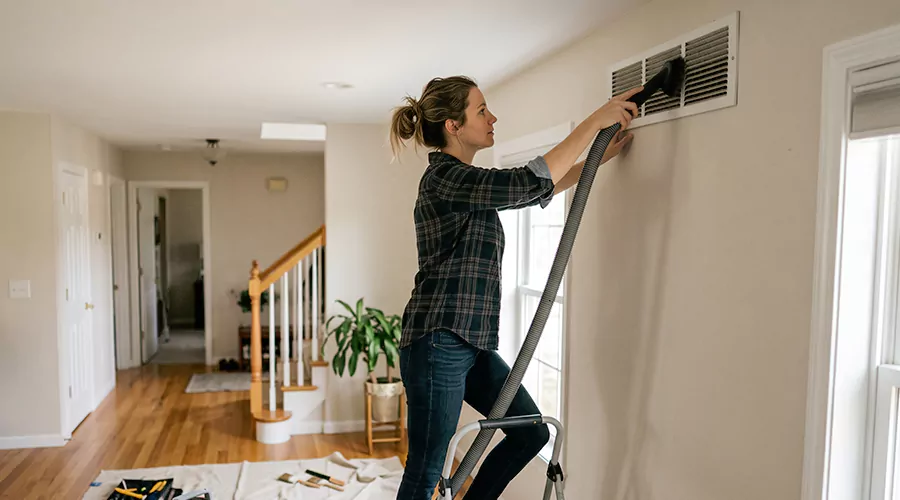
Air vent cleaning commonly costs $25 to $50 per supply vent when priced as part of a professional HVAC duct-cleaning service in the United States in 2026. Return vents may cost $40 to $75 each under separate return-vent pricing. These rates generally relate to cleaning the connected duct branches, not simply wiping the removable vent covers. Local vent cleaning services can help homeowners understand the available cleaning options. Cleaning only the visible grilles is usually a smaller household maintenance task.
Air vents are the openings where conditioned air enters rooms or returns to HVAC equipment. Dust gradually collects on their surfaces as particles move through the home. Supply vents and return grilles may need ordinary surface cleaning even when the ductwork behind them remains in acceptable condition.
The price depends on what a contractor means by vent cleaning. One service might involve washing the visible covers, while another includes specialized vacuuming and brushing inside the connected ducts. A full-system service may also address trunk lines, plenums, and accessible equipment components.
Understanding these differences is important because the same phrase can describe very different amounts of work. A professional cleaning price should identify exactly which components are included before homeowners compare estimates.
What Is the Average Air Vent Cleaning Cost in 2026?
Published 2026 U.S. cost guides commonly estimate $25 to $50 for each supply vent under per-vent duct-cleaning pricing. Return vents may cost $40 to $75 because they can connect to larger passages. Professional whole-system duct cleaning averages approximately $390 in Angi's national pricing data, with many projects costing $271 to $509.
These amounts describe related pricing methods rather than separate charges that must always be combined. A contractor may use the number of vents to calculate a whole-house price. Another may quote a flat fee covering the complete air distribution system.
| Cleaning Service | Typical 2026 U.S. Cost |
|---|---|
| Supply vent under per-vent duct cleaning | 25–50 each |
| Return vent under separate return pricing | 40–75 each |
| Typical planning midpoint for a vent | Approximately $35 |
| Standard residential air duct cleaning | 271–509 |
| National average air duct cleaning | Approximately $390 |
| Broader whole-house cleaning estimate | 450–1,000 |
| Vent-cover-only dusting or washing | Usually DIY or quoted separately |
The rates for supply and return vents should not be mistaken for a standardized price to wash a grille. Standalone grille cleaning does not have a well-established national price because it is often completed as ordinary housekeeping or included in another service.
The cost is most meaningful when paired with a clear description of what the contractor will do. Removing a dusty grille and wiping it takes different equipment and labor from cleaning a connected duct branch. The estimate should explain that distinction.
What Is the Difference Between Air Vent Cleaning and Air Duct Cleaning?
Air vent cleaning can refer to the visible openings in floors, walls, or ceilings. Air duct cleaning generally involves the passages that carry air behind those openings. The two services overlap when a professional duct cleaning includes removal and cleaning of the registers.
A homeowner can often clean vent covers with a vacuum and mild detergent. Professional duct cleaning uses more involved equipment to loosen and collect material from concealed passages. These methods are not equivalent even when the contractor describes both as vent cleaning.
Vent Cover Cleaning
Vent cover cleaning addresses the exposed grille and the nearby opening. The cover may be removed and washed if its material permits. Dust along the frame and louvers is then collected before the grille is reinstalled.
This is a common household task and usually does not require a specialist. A cleaner may offer it as part of a general home cleaning visit, but charges depend on the company's service arrangement. Paying for full duct cleaning is generally unnecessary when only the visible cover is dusty.
Duct Branch Cleaning
Duct branch cleaning involves the passage extending behind the vent. A professional may use specialized brushes or air agitation tools with vacuum collection to remove substantial deposited material. The technique must be compatible with the duct material.
When contractors advertise a per-vent duct cleaning price, this deeper work is often what the charge is intended to represent. However, the exact scope varies. Homeowners should confirm whether the price covers the branch all the way to the main duct.
Whole-System Cleaning
Whole-system cleaning considers supply and return ducts along with applicable HVAC components. The scope can include plenums, blower assemblies, and other affected parts, depending on the condition and the service agreement. The work usually requires several hours and specialized collection equipment.
The Environmental Protection Agency advises that when contaminated HVAC systems are cleaned, affected connected components should be addressed appropriately. Cleaning only some parts of a contaminated system can allow remaining material to affect cleaned sections. The contractor should therefore explain what is included and why.
What Factors Affect Air Vent Cleaning Prices?
The cost of vent cleaning depends on the number and type of openings, along with the work being performed. Accessibility and duct material also influence professional cleaning prices. A large home with several HVAC systems may require more labor than a smaller property with one straightforward system.
Number of Supply Vents
Each supply vent connects to a branch delivering conditioned air to a room. Homes with more rooms often have more supply openings, although the number varies with the HVAC design. Under per-vent pricing, each additional branch generally increases the quoted amount.
A contractor should count the actual registers rather than estimate their number from the home's square footage alone. Two similar-sized houses may contain different duct layouts. A room may also have several supply vents or no conventional duct outlet.
Number and Size of Return Grilles
Return grilles draw indoor air back toward the HVAC system. They are often larger than supply openings and may connect to substantial return passages. Some companies therefore charge a different rate for return cleaning.
A home may have several supply vents but only one or two major returns. Another home may have returns in multiple rooms. Counting the return openings separately helps prevent surprises when the contractor arrives.
Accessibility of the Vents
Floor vents are often easy to reach, while high ceiling grilles may require additional access equipment. Furniture and built-in cabinetry can also obstruct openings. A contractor may need more time when several covers are difficult to remove or reach.
Accessibility becomes more important when the connected ductwork needs cleaning. An opening located in a finished ceiling may not provide sufficient access to the entire branch. Additional service openings may be necessary for appropriate source removal.
Type of Duct Material
Rigid sheet metal ducts may permit cleaning methods that are not suitable for flexible liners or fiberglass duct board. Delicate materials require careful handling to prevent damage. The contractor should identify the duct construction before choosing equipment.
A damaged duct may require repair rather than aggressive cleaning. For example, a torn flexible liner can become worse if an unsuitable rotating brush is used. Material condition can therefore affect both the cleaning method and the project cost.
Amount of Deposited Material
A vent covered with ordinary household dust can usually be cleaned quickly. A duct containing substantial construction debris may require more intensive collection and inspection. The condition should be documented before a contractor recommends extensive work.
Ordinary dust on a return grille does not prove that the entire HVAC system is contaminated. The EPA specifically notes that return registers commonly collect dust from air moving through them. Cleaning needs should be determined from the actual duct condition.
Number of HVAC Systems
A home served by two independent heating and cooling systems may require two separate cleaning setups. Each system can have its own returns, supply branches, and equipment. This may create a higher total than cleaning one system with a similar number of vents.
The contractor should identify how many systems are covered in the quote. A price advertised for one system may not include additional air handlers or separate duct networks.
How Much Does Air Vent Cleaning Cost for Different Home Sizes?
Some contractors use home square footage to estimate cleaning costs rather than count every vent. Larger homes generally contain more ductwork and may take longer to clean. However, home area is only a pricing approximation because actual duct layouts vary.
Published U.S. estimates commonly use $0.20 to $0.40 per square foot for certain whole-house duct-cleaning services. Applying this range produces the following illustrative amounts.
| Home Size | Example Whole-House Cleaning Cost |
|---|---|
| 1,000 square feet | 200–400 |
| 1,500 square feet | 300–600 |
| 2,000 square feet | 400–800 |
| 2,500 square feet | 500–1,000 |
| 3,000 square feet | 600–1,200 |
These are mathematical estimates using one published pricing method, not guaranteed invoices. A minimum service charge may result in a higher price for a small house. Likewise, a large property with accessible ductwork may receive a different quote from a company using flat-rate pricing.
Square-foot estimates should not be added to per-vent calculations unless the contractor explicitly identifies a separate charge. These are alternative pricing methods that may describe the same work.
Is It Cheaper to Clean Air Vent Covers Yourself?
Cleaning accessible grille covers yourself is usually less expensive than hiring a duct-cleaning specialist. A vacuum and microfiber cloth are sufficient for many ordinary deposits. Removable washable covers may also be cleaned with mild detergent, provided their finish and construction permit it.
The time required depends on the number of openings and their locations. Floor grilles may be easy to remove, while high ceiling vents can take more time. The task should remain limited to accessible surfaces rather than involve deep cleaning inside concealed ducts.
DIY cleaning is less appropriate when substantial internal contamination is suspected. Pest material and significant mold-like growth require a different assessment. Disturbing these materials with ordinary household tools may spread particles or damage the duct.
The main savings come from matching the maintenance task to the actual problem. If only a grille is dusty, household cleaning may be enough. If significant debris is documented inside the HVAC system, a professional service may be justified.
What Should Be Included in Professional Air Vent Cleaning?
A professional vent cleaning service should define whether it covers the grilles alone or the duct branches behind them. A clear scope prevents confusion over what has been cleaned. The work should also protect surrounding surfaces and restore covers to their original positions.
For a service involving connected ductwork, the contractor may clean supply and return branches using suitable agitation and vacuum collection equipment. The provider should inspect the duct material before choosing tools. Negative-pressure collection can help prevent disturbed particles from entering occupied rooms.
A whole-system service may include additional HVAC components when they are part of the agreed scope. The blower and plenums, for example, can contain deposits that require different cleaning methods from ordinary grille surfaces. Equipment servicing and duct cleaning should be clearly distinguished in the estimate.
A complete service should leave accessible openings clean and securely reattached. The technician should also verify that adjustable dampers were not unintentionally changed. Any temporary access openings created during cleaning must be sealed appropriately.
What Additional Charges Can Increase Air Vent Cleaning Costs?
Extra charges may arise when the requested work goes beyond ordinary cleaning. Inspection and equipment cleaning can add labor, while damaged ductwork may require repair. The contractor should identify these tasks separately before beginning additional work.
| Additional Service | Indicative 2026 U.S. Cost |
|---|---|
| Video duct inspection | 70–130 |
| HVAC inspection | 100–300 for some projects |
| Dryer vent cleaning when bundled | Around $100 |
| Standalone dryer vent cleaning | 100–170 in some estimates |
| Duct repair | Approximately 200–800 for some repairs |
| Mold or pest-related remediation | Separate assessment and estimate |
These are different services and should not automatically be added to the base cleaning fee. Some contractors include an inspection within their initial quote. A dryer vent is also a separate exhaust system and should not be assumed to be covered by ordinary HVAC vent cleaning.
Chemical treatments deserve caution. Deodorizers and antimicrobial products are not automatically needed for ordinary dust. The contractor should explain the purpose and suitability of any proposed product before using it inside the system.
Is Professional Air Vent Cleaning Worth the Cost?
Professional cleaning can be worthwhile when significant deposits have been documented inside the connected ductwork. It can also help address specific debris remaining after appropriate pest remediation or construction contamination. However, these conditions should be evaluated before scheduling cleaning.
The EPA does not recommend routine duct cleaning solely because normal dust is present. Research has not conclusively demonstrated that ordinary duct cleaning prevents health problems or consistently reduces household dust. Claims that every home needs frequent cleaning should therefore be treated cautiously.
If only the removable vent covers are dirty, cleaning them yourself may be the more practical choice. Professional work is better suited to internal contamination that cannot be addressed safely through household maintenance. The value depends on what the service actually removes.
How Often Should Air Vents Be Professionally Cleaned?
Visible grille covers can be cleaned whenever dust accumulates. A monthly check and deeper surface cleaning every few months may be suitable for many households. These tasks are different from professional source removal inside the ducts.
There is no universal professional duct-cleaning interval that applies to every home. The EPA recommends an as-needed approach based on specific conditions. Routine HVAC maintenance and filter replacement should continue regardless of whether duct cleaning is scheduled.
Homes affected by substantial renovation debris or pest contamination may have a specific reason for professional cleaning. Another home with dry, well-maintained ductwork may not need the same service. The decision should follow inspection findings.
How Can You Avoid Overpaying for Air Vent Cleaning?
The easiest way to avoid unnecessary charges is to define what needs cleaning before requesting a quote. A dusty grille may not justify a full-system service. When internal cleaning is appropriate, contractors should describe the components included and how they will collect the debris.
Before booking, ask:
- Does the quote cover vent covers only or the ducts behind them?
- Are supply and return vents priced separately?
- How many vents and HVAC systems are included?
- Is the main ductwork included in per-vent pricing?
- Are plenums or other equipment components included?
- Will temporary access openings be restored?
- Are additional inspection or treatment charges possible?
- Can the provider document the conditions justifying cleaning?
Written estimates make it easier to compare services fairly. A low price is not necessarily a bargain when it covers only visible openings. An expensive package is also not automatically justified when the ductwork contains no significant contamination.
When Should You Call a Professional?
Professional inspection is appropriate when substantial debris appears to be coming from the ductwork rather than collecting on the grille surface. Significant suspected mold or pest contamination also requires further evaluation. These conditions may involve work that should not be performed with ordinary household cleaning tools.
A qualified cleaner should identify the duct materials and use suitable collection equipment. The contractor should be able to explain why cleaning is recommended and which components are affected. A written scope helps prevent unnecessary additions during the visit.
If moisture is involved, the source should be corrected before cleanup. Wet insulation or damaged duct materials may require replacement rather than simple cleaning. Proper diagnosis helps prevent the same condition from returning.
How Can You Reduce Future Air Vent Cleaning Expenses?
Regular surface maintenance helps prevent heavy visible deposits from building up around grilles. Vacuum return covers during household cleaning and check floor vents for loose debris. Keeping the openings accessible also makes occasional cleaning easier.
Replace HVAC filters according to the equipment manufacturer's instructions. A properly fitted filter helps limit particles reaching downstream components. Damaged return connections should also be repaired because they can draw dust from unconditioned spaces.
During dusty renovation work, protect duct openings appropriately and avoid operating the HVAC system while substantial debris is airborne when practical. Remove the protective coverings before restoring normal operation. These measures help reduce the chance of construction dust entering the duct network.
Conclusion
Air vent cleaning commonly costs $25 to $50 per supply vent under professional duct-cleaning pricing, while return vents may cost $40 to $75 each. Cleaning only the visible grille is a smaller maintenance task and often does not require professional duct-cleaning equipment. Whole-system prices depend on the duct layout and components included. Ordinary surface dust does not automatically justify deep cleaning. Before hiring a contractor, confirm whether the quote covers vent covers, duct branches, or the complete HVAC system.